Orthopedic Malpractice Claims Dominated by Surgical Allegations, TDC Analysis Finds
October 5, 2026
bySurgical treatment accounts for nearly four out of five medical malpractice claims involving orthopedic care, according to a new claims analysis from The Doctors 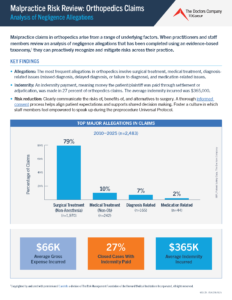 Company that also identifies technical skill, clinical judgment and communication as significant contributors to patient harm.
The Doctors Company analyzed 2,483 orthopedic malpractice claims from 2010 through 2025 for its October “Malpractice Risk Review.” The report examines allegations, contributing factors and indemnity payments and includes a case study illustrating the potential consequences of missed follow-up after orthopedic surgery.
Surgical treatment was the primary allegation in 79% of the claims studied, far exceeding medical treatment at 10%, diagnosis-related allegations at 7% and medication-related allegations at 2%. Diagnosis-related allegations included missed, delayed and failed diagnoses.
The analysis found that 27% of closed orthopedic claims resulted in an indemnity payment. Average indemnity incurred was $365,000, while average gross expense incurred was $66,000.
The findings are part of The Doctors Company's 2026 monthly series examining malpractice risks within individual medical specialties using claims data.
Technical Skill Leads Contributing Factors
Technical skill was the most frequently identified contributing factor, appearing in 68.75% of cases. The category includes issues involving technical performance, retained foreign bodies and improperly used equipment.Behavior-related factors appeared in 40.88% of cases, followed by clinical judgment at 38.66%, communication at 29.12% and documentation at 14.46%. Because claims can involve more than one contributing factor, the percentages exceed 100%.
Frequency, however, did not necessarily correspond with financial severity.
Clinical judgment carried the highest mean gross payment incurred among the five major contributing-factor categories, at $430,000. Documentation followed at $406,000, technical skill at $381,000, communication at $374,000 and behavior-related factors at $268,000.
The Doctors Company said communication problems can include exchanges between practitioners and patients or families as well as communication among healthcare practitioners. Patient behavior that reduces adherence to a treatment plan also can contribute to claims.
The insurer recommended several risk-reduction strategies, including careful patient selection, accurate and timely documentation and clear communication about treatment plans and follow-up. It also recommended that physicians confirm patient understanding by asking patients to repeat information provided to them.
Missed Test Result Highlights Follow-Up Risk
The report also includes a case study involving a patient who developed a surgical-site infection following a total knee arthroplasty.A week after surgery, the patient returned with moderate knee swelling and mild erythema. Over the following months, fluid was aspirated three times, two irrigation and debridement procedures were performed and the polyethylene liner was revised.
A mycobacteriology report subsequently identified numerous Mycobacterium abscessus organisms. According to the case study, documentation indicated that the orthopedic surgeon reviewed and acknowledged the result. At a later visit, however, the surgeon documented that laboratory studies and cultures were negative for infection.
The patient eventually sought a second opinion and was diagnosed with a prosthetic joint infection. Revision surgery was performed and six of seven operative debridement specimens grew M. abscessus. About a year after the original knee replacement, the patient was scheduled for an above-knee amputation but died before the procedure. The death certificate identified septic shock as the cause of death.
The Doctors Company identified failure to recognize and respond to test results as a key contributing factor, noting that the surgeon had documented reviewing the positive result but failed to act on it.
The insurer recommended standardized systems for reconciling ordered tests with received results, ensuring physician review and follow-up, and separately tracking high-risk orthopedic results such as surgical pathology findings and positive cultures following joint replacement.
The case demonstrates that test-result management can become both a patient-safety and malpractice-defense issue. The Doctors Company noted that earlier recognition and diagnosis might not have changed the patient’s clinical course but could have strengthened the physician’s defense.
The Doctors Company said its monthly malpractice reviews are intended to help physicians and healthcare organizations identify recurring patterns in claims and use those findings to improve patient safety and reduce liability exposure.

Leave a Reply